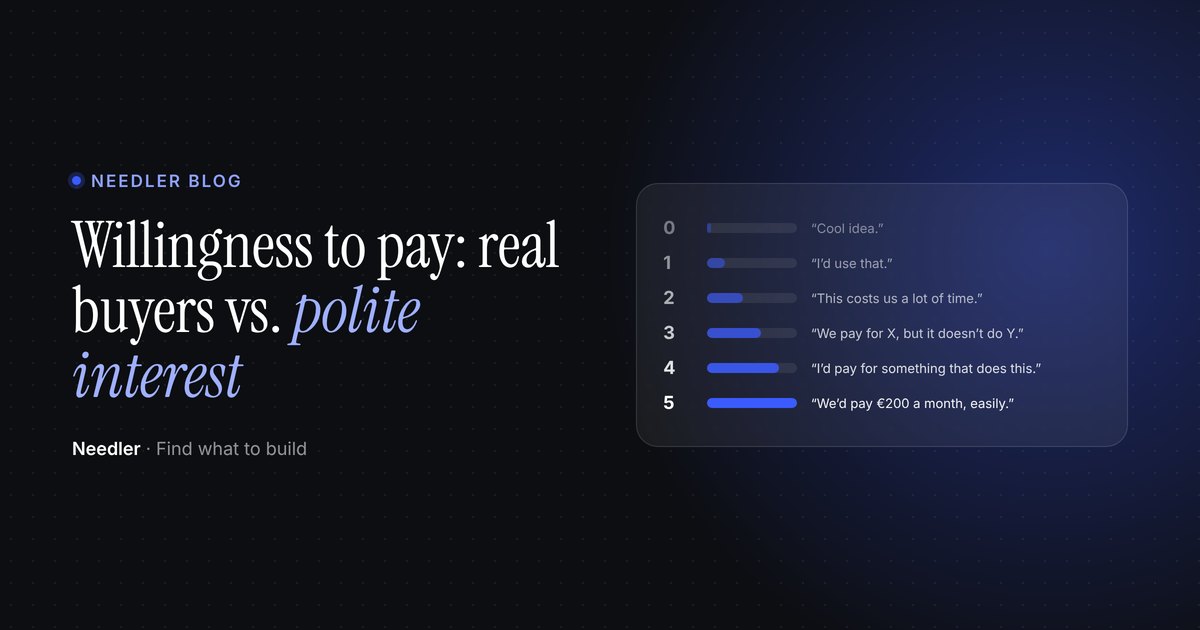
Every founder has had this conversation. You describe your idea, the other person's eyes light up, and they say: "Oh, I'd totally use that." You go home and start building.
Six months later, that person doesn't sign up. They didn't lie. They meant it the way people mean "we should get coffee sometime". Liking an idea and paying for it are different decisions, made in different moods, often by different people.
This post is about telling those apart, both when you're reading what people write online and when you're talking to them.
Why people say yes and don't buy
Three reasons, all of them innocent:
- Politeness. Telling someone their idea is bad is uncomfortable. "Sounds useful!" is the easy way out.
- Hypotheticals are free. "Would you use X?" costs nothing to answer with yes. Using it costs time, setup, a budget request and a change in habit.
- The wrong person. The person who likes the idea is often not the one who controls the budget, or not the one who'd have to change how they work.
Rob Fitzpatrick's book The Mom Test is built on this observation, and it's worth reading in full. Its core rule: ask about their life and what they've done, not about your idea and what they would do.
A 0–5 scale for willingness to pay
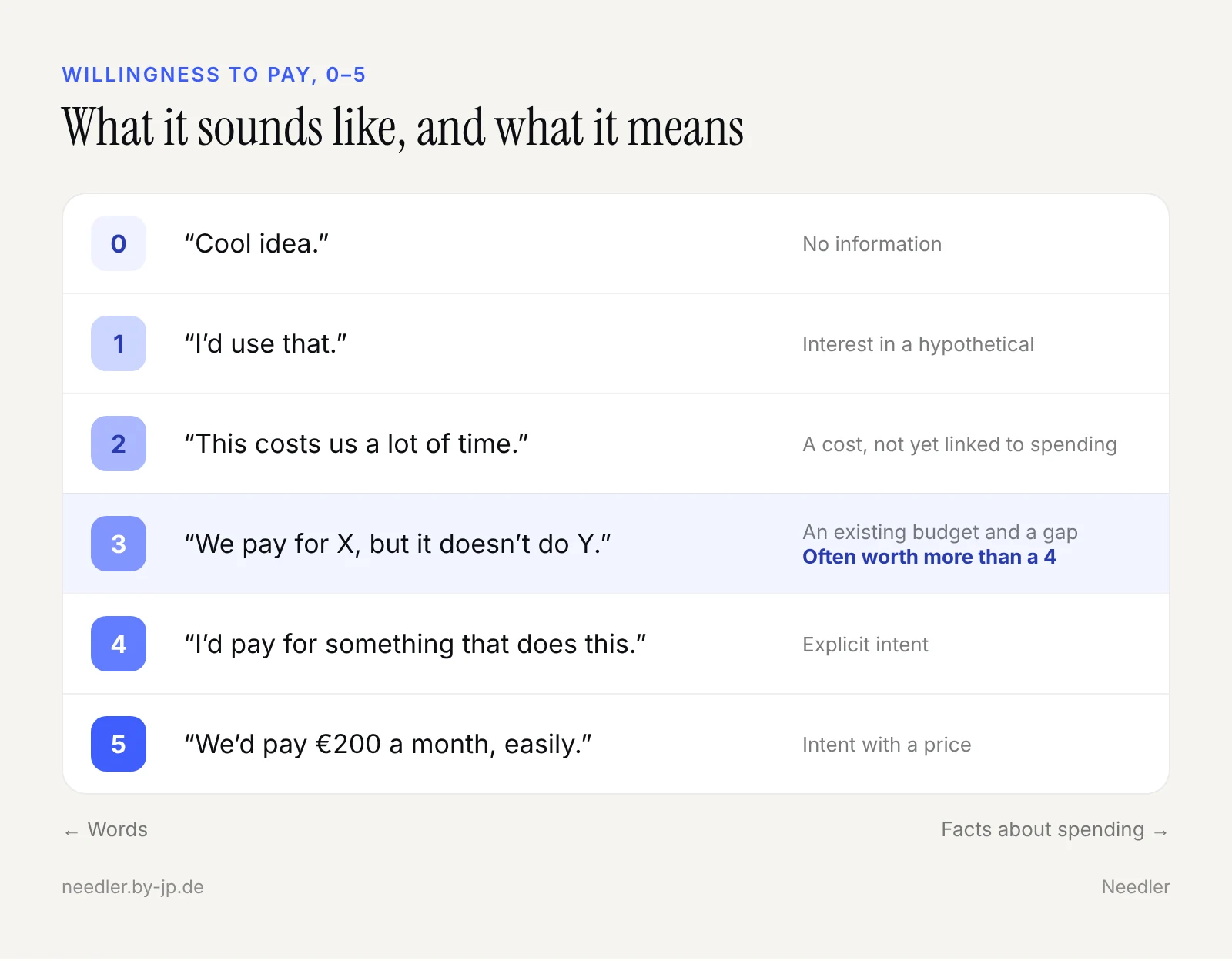
When Needler rates posts, willingness to pay is one of six strength signals, scored from 0 to 5. The scale is useful by hand too, whether you're reading a forum thread or your own interview notes.
| Score | What it sounds like | What it means |
|---|---|---|
| 0 | "Cool idea." | No information. Interest, at most. |
| 1 | "I'd use that." | Interest in a hypothetical. Not demand yet. |
| 2 | "This costs us a lot of time." | The problem has a cost, but nobody has linked it to spending. |
| 3 | "We pay for X but it doesn't do Y." | They have a budget in this area and an unmet need. |
| 4 | "I'd pay for something that just does this." | Explicit intent, without a number. |
| 5 | "We'd pay €200 a month for this, easily." | Explicit intent with a price or budget. |
Two things about this scale are easy to miss.
First, level 3 is often worth more than level 4. "I'd pay for this" is still a hypothetical. "We already pay €80 a month for a tool we dislike" is a fact about their current spending.
Second, level 5 is rare, and that's fine. You don't need everyone to name a price. You need a pattern: several people at level 3 or higher, describing the same problem.
Signals in what people write online
When you read forums, reviews and threads, these are the phrases that move a post up the scale:
- A named tool they pay for: "we're on the €49 plan of…", "our Salesforce bill…"
- A complaint about price: "too expensive for a team our size", "they doubled the price". A pricing complaint is evidence of a budget and of a gap below the incumbent.
- Hours or headcount: "it takes our ops person a full day each month", "we hired a VA just for this". Time is money with an extra step.
- Something they built: an internal tool, a script, a Zapier chain with eleven steps. Building is the most expensive way to pay.
- A switch: "we moved from X to Y because…". People who switch are people who make buying decisions.
And these are the ones that sound like demand and aren't:
- "Someone should build…"
- "Would be nice if…"
- "Upvoted, I'd use this!"
- Anything in a thread about startup ideas, where people are discussing ideas rather than their own work.
Interview questions that get honest answers
If you're talking to someone, avoid asking whether they'd buy. Ask about what they did. Some questions that work:
- "When did this last happen?" If they can't remember, it doesn't happen often enough.
- "What did you do about it?" You're looking for a workaround. "Nothing, really" is a no.
- "What does that cost you, roughly?" Hours, money, missed revenue, annoyed customers.
- "Have you looked for a tool for this? What happened?" Searching is effort. Effort is a form of payment.
- "Who would sign off on buying something for this?" It tells you whether you're talking to the buyer, and how long a sale takes.
- "What are you paying for in this area today?" This is the level 3 question. It gets you a real number without asking them to predict anything.
Questions to avoid: "Would you use…", "Would you pay for…", "How much would you pay for…". Each one invites a polite guess.
The only real test: ask for money
Everything above is a proxy. The real signal is a payment, or something close to it. Before you build, you can ask for:
- A pre-order at a launch discount, refundable if you don't ship.
- A paid pilot for a small amount, for a business customer.
- A letter of intent for larger B2B deals: not binding, but people don't sign them casually.
- Their time: a weekly call during development, or access to their real data. Time is a weaker currency than money, but much stronger than words.
If people with the problem won't give you any of these, it's useful information, and much cheaper to learn now than after six months of building. My seven-day validation plan shows how to fit a pre-sale into the first week.
A short example
Here are three replies to the same imagined question, "How do you handle client onboarding paperwork?", from three accountants:
- A: "Ugh, it's a mess. Would love an app for it." → Level 1. Real frustration, no evidence of cost.
- B: "We email PDFs back and forth and my assistant chases missing documents. Takes her about a day a week in tax season." → Level 2, close to 3. A clear cost in hours.
- C: "We pay for a client portal but nobody uses it, so we're back to email. I'd switch tomorrow if something worked with how clients actually behave." → Level 3 with a switching intent. An existing budget and a specific failure.
You'd build for C. You'd interview B to see whether others have the same pattern. A is pleasant to talk to, and nothing more.
Every brief Needler produces shows its willingness-to-pay score next to the other five signals, so you can see at a glance whether anyone mentioned money. This week's free idea is a good example to start with.