With AI coding tools, you can have a working prototype by Sunday evening. That's great, and also a trap: when building is that fast, it feels faster to build first and find out later. It usually isn't. Code you write before you know who it's for is the most expensive kind, because you'll be tempted to keep it.
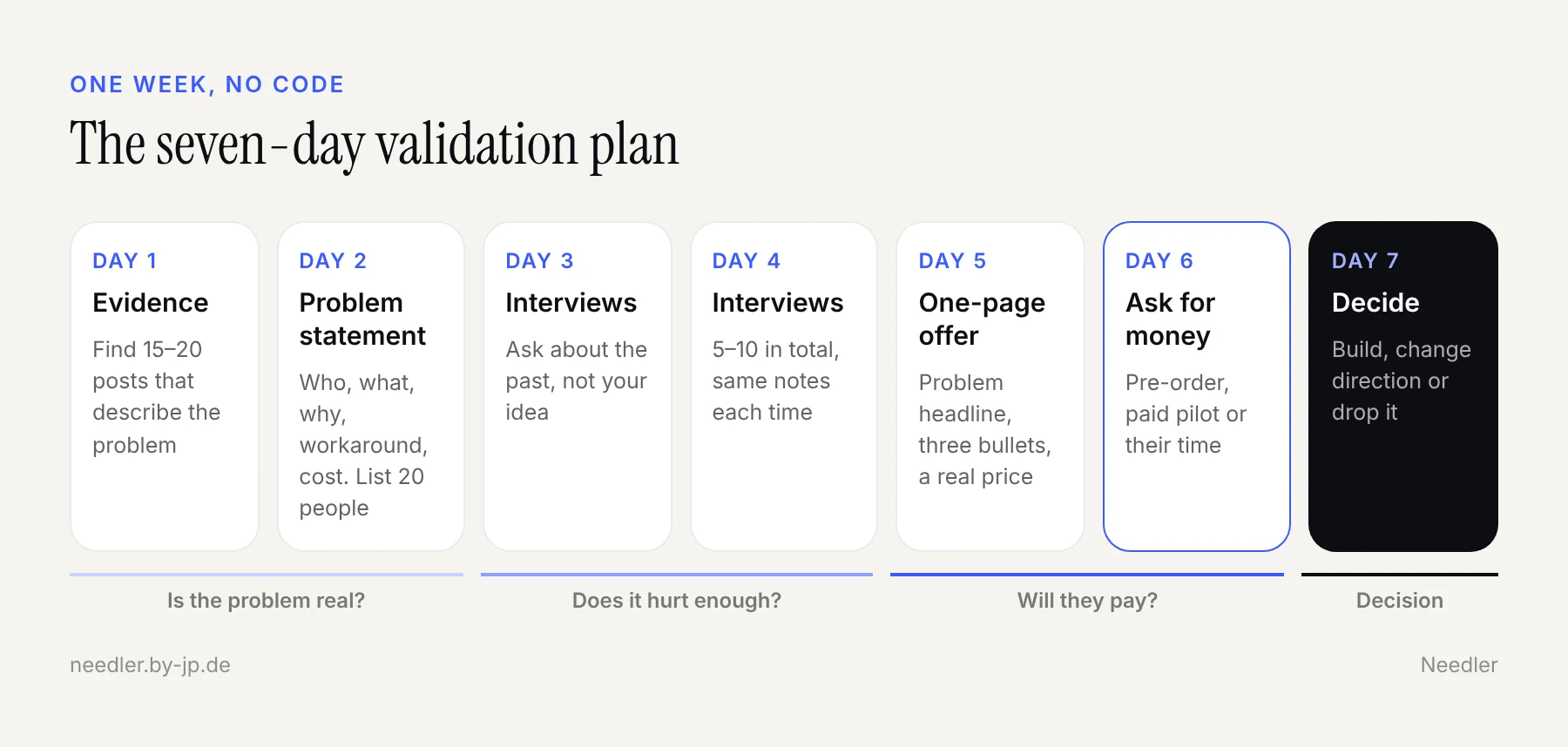
Here's the week I'd spend instead. No code, about two hours a day, and at the end a clear decision: build, change direction or drop it.
Before you start: write down what would change your mind
Take five minutes and write two sentences:
- "I'll build this if…" (e.g. at least five of ten people describe the problem without prompting, and two pre-order)
- "I'll drop this if…" (e.g. fewer than three of ten have done anything about it in the last month)
You'll be tempted to move these lines later in the week, and writing them down first makes that harder.
Day 1: collect evidence that the problem exists
Before you talk to anyone, find out whether people already talk about the problem on their own.
- Search forums, Reddit, Hacker News, reviews and GitHub issues for the problem in several phrasings. My list of Hacker News search queries works elsewhere too.
- For each relevant post, note who has the problem, what they do today, how often it happens and whether money or time is mentioned.
- Stop at 15–20 posts or two hours, whichever comes first.
Good sign: different people in different places describe the same problem, with details. Bad sign: you only find people saying "someone should build this".
Day 2: write the problem statement and find people to talk to
Turn your notes into one sentence, in this shape:
[Who] struggles to [do what] because [why], and today they [workaround], which costs them [cost].
For example: Freelance translators struggle to see which clients still owe them money because invoices live in three different tools, and today they keep a spreadsheet they update by hand, which costs them a few hours a month and occasionally a missed payment.
If you can't fill every blank, Day 1 isn't finished.
Then make a list of 20 people who match the "who". The authors of the posts you found are a good start. Professional communities, LinkedIn and your own network fill the rest. Send short, honest messages: you're researching a problem, not selling anything, and you'd like 20 minutes of their experience. Expect around a third to say yes.
Days 3 and 4: talk to five to ten people
This is the most important part of the week. Keep the conversations about their past, not your idea:
- Walk me through the last time this happened.
- What did you do about it?
- What does it cost you, in time or money?
- What have you tried? What was wrong with it?
- Who else is involved when this goes wrong?
- What are you paying for in this area today?
Don't pitch until the last five minutes, if at all. Take notes in the same fields as on Day 1 so you can compare. I wrote more about questions that get honest answers.
After each conversation, write one line: Would this person pay to make the problem go away? Why or why not?
Good sign: people get animated, show you their workaround, ask when they can try it. Bad sign: polite agreement, vague answers, "I guess it would be nice".
Day 5: put up a one-page offer
Write a simple landing page with a no-code tool. It needs only four things:
- A headline that names the problem in the words people used in your conversations, not the solution in your words.
- Three bullets on what changes for them.
- A price. A real one. Leaving it out removes the most useful part of the test.
- One call to action: "Join the waitlist", or better, "Pre-order at 50% off".
Send it to the people you talked to and post it where they gather, if the community allows it. If you run ads, a small budget for a narrow audience is enough to see whether strangers click; it's not enough to judge conversion rates precisely, so don't over-read the numbers.
Day 6: ask for money
Go back to the people who were most enthusiastic and ask for something real:
- A pre-order with a launch discount, refundable if you don't ship.
- A small paid pilot, for a business.
- At minimum, a commitment of their time: a weekly call while you build, or access to their real data.
This is uncomfortable, and that's why it's useful. If nobody who has the problem will pay anything, even with a refund guarantee, you've learned in a day what usually takes months.
Day 7: decide
Put your notes next to the two sentences you wrote before Day 1, and decide.
| What you saw | Decision |
|---|---|
| Several people with the problem, a costly workaround, at least one or two pre-orders or pilots | Build the smallest version that solves the core problem for them. |
| Problem confirmed, but for a different group or with a different core pain than you assumed | Change direction: rewrite the problem statement and repeat Days 2–6 for the new group. |
| Polite interest, no workaround, no money | Drop it, and keep your notes. You'll recognise the pattern faster next time. |
Dropping an idea after a week isn't a failure: apart from finding a good one, it's the cheapest outcome there is.
What this week doesn't tell you
Ten conversations and a landing page won't tell you the size of the market, whether people keep paying after month three, or whether you can reach customers profitably at scale. They tell you whether the problem is real and painful enough for some people to pay to solve it. That's the question you can't afford to get wrong, so it comes first.
Starting with better raw material
The slowest part of the week is Day 1. Starting from a problem you made up, you spend hours looking for proof. Starting from a problem someone already described in public, with the workaround and the cost, you start at Day 2.
That's what Needler is for. It reads thousands of public posts and comments a day and turns the problems people describe into briefs with six strength scores: who has the problem, what they do today and what it costs them. Every Monday I pick one brief and give it away for free. Treat it as Day 1, done for you, and spend the rest of the week on the part that only you can do: talking to people.