Hacker News is one of the best places on the internet to find software problems, for an unusual reason: the people there explain why. A comment rarely says "this tool sucks". It says which tool, what they tried instead, how big their team is, and what it cost them. That's the detail you need to judge a problem.
The front page is the wrong place to look, though. The good material is in the comments, years deep, and you need the search to get at it. This post is the set of queries I keep coming back to.
The basics of hn.algolia.com
Hacker News search runs on hn.algolia.com. Three settings matter more than the query itself:
- Search in "Comments", not "Stories". Stories are links and headlines. Problems are described in comments.
- Sort by "Date" when you're looking for current pain, "Popularity" when you want the threads where many people chimed in.
- Limit the time range to "Past year". Problems from 2014 may have been solved three times since.
"Ask HN" as a type is worth a separate pass. "Ask HN: How do you handle X?" threads are a ready-made survey: one question, fifty people describing their workaround.
Put phrases in quotes. Algolia is forgiving with typos and word order, which is nice for normal search and annoying when you want a specific phrase.
12 queries that find problems
Each query is a phrase people use when they have a problem, not when they're talking about one in the abstract. Combine them with a domain word ("invoice", "kubernetes", "clinic", "translation") to narrow down.
People who searched and didn't find
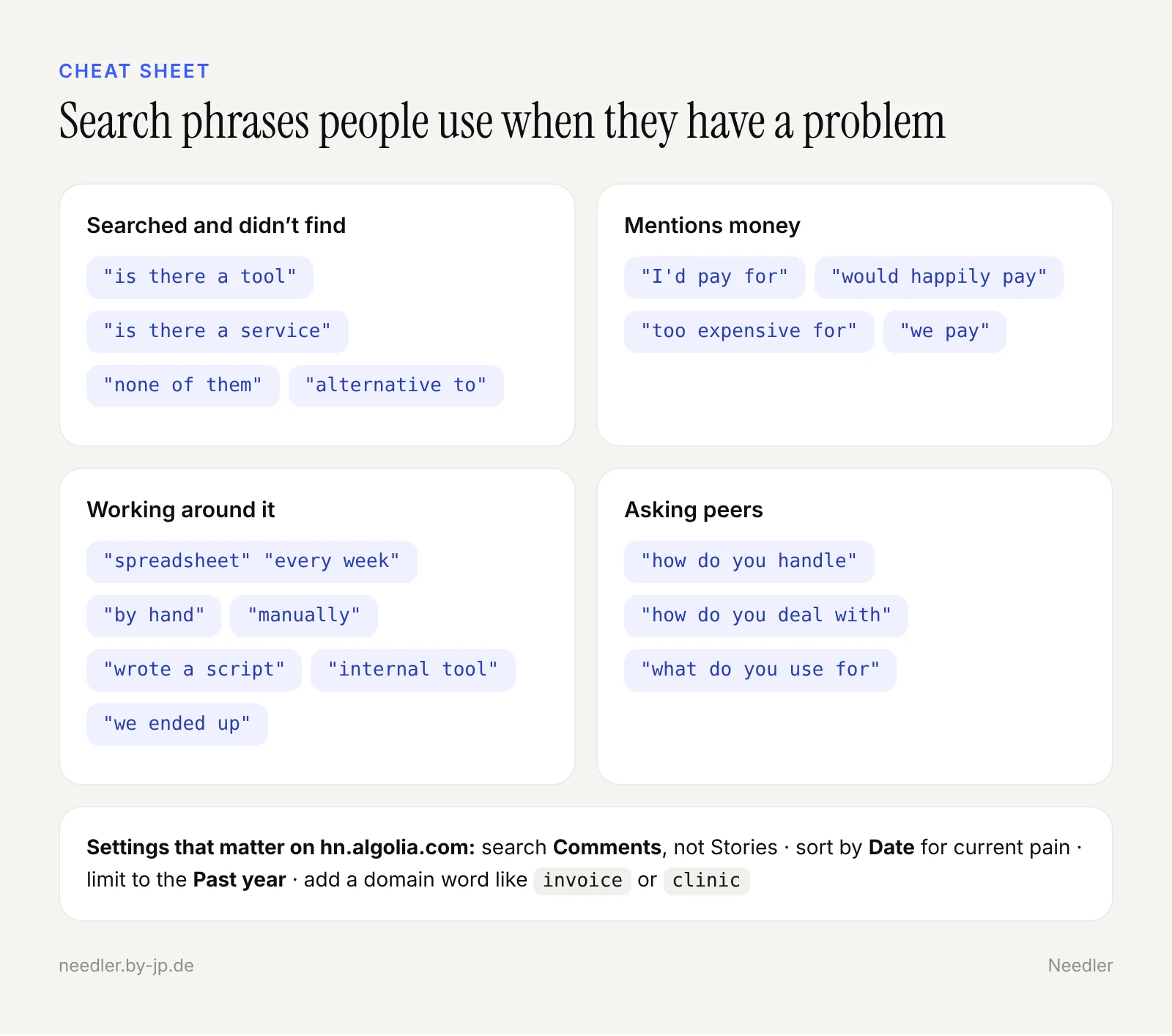
"is there a tool"and"is there a service". The most direct form of unmet demand. Look at the replies: if they're all "not really" or "I wrote a script", you've found a gap."none of them", as in "I tried four tools and none of them handle…". The person has done your competitive research for you."alternative to". People leaving a product tell you exactly what it does wrong. Pair it with a product name.
People who mention money
"I'd pay for"and"would happily pay". Rare, valuable, and always worth reading in context. Sometimes it's sarcasm."too expensive for". Usually followed by "small teams", "a solo dev" or "a non-profit". That's a pricing gap under an existing market, which is one of the safest places to start."we pay"plus a tool category, e.g."we pay" compliance. You learn what a problem is worth to a company that already has a budget for it.
People who are working around it
"spreadsheet"with"every week"or"every month". A recurring spreadsheet is a product spec written by someone who couldn't buy the product. More on that in the spreadsheet test."by hand"and"manually". "We still reconcile these by hand" is a complaint with a frequency and a cost built in."wrote a script"and"internal tool". When a company builds its own tool for something, the problem was worth an engineer's time. Other companies have it too and don't have the engineer."we ended up". As in "we ended up hiring someone just for this". This phrase almost always comes after a story about something that didn't work.
People asking peers
"how do you handle"and"how do you deal with", especially as Ask HN. The answers are a list of workarounds, ranked by how many people use them."what do you use for". The replies show you the incumbents, and the follow-up replies show you why people don't like them.
How to read a thread
The query finds the comment. The thread around it tells you whether it matters.
- Count the people, not the upvotes. Three separate replies that say "same here, we do X" are worth more than one comment with 200 points.
- Look for job and company size. "At our 8-person agency" is useful. "I think people would want" isn't.
- Read the replies that disagree. "Just use Y" followed by "Y doesn't do Z" tells you what the existing answer is missing.
- Check the date of the last reply. A two-year-old thread where someone writes "still no good solution" last month is a strong signal.
Then take notes in a fixed format: who, problem, what they do today, how often, what it costs, any mention of paying. The six-field table from my guide to finding startup ideas works well.
Collecting results with the API
Once you have queries that work, you'll want to run them every week without clicking through the UI. Algolia's HN API is public and needs no key.
# Comments from the past 30 days containing "is there a tool", newest first
since=$(( $(date +%s) - 30*24*3600 ))
curl -s "https://hn.algolia.com/api/v1/search_by_date?query=%22is%20there%20a%20tool%22&tags=comment&numericFilters=created_at_i>$since&hitsPerPage=50" \
  | jq -r '.hits[] | "\(.created_at[:10])  https://news.ycombinator.com/item?id=\(.objectID)\n\(.comment_text[:300])\n"'
A few useful parameters:
tags=comment,tags=storyortags=ask_hnlimit the type.searchsorts by relevance,search_by_dateby date.numericFilters=points>20ornum_comments>30find the threads with traction (on stories).hitsPerPagegoes up to 1000 per request.
Run your twelve queries, dump the results into a file, and read them once a week with a coffee.
Limits worth knowing
Hacker News has a strong bias. Most people there are developers, founders or work close to tech. You'll find many developer-tool problems and comparatively few from dentists, farmers or logistics planners, even though those markets are larger. When you find something good, look for the same problem in a profession-specific community before you trust that it's widespread.
It's also a place where people like to build things themselves. "I'd just write a script for that" is a common reply, and it can make a real problem look trivial. The people with the problem usually can't write the script, which is exactly why they'd pay.
Or let something else do the reading
Needler does this kind of reading every day, over thousands of posts. Rules set aside the small talk, a language model judges which of the rest describe a real need, and the result is a structured brief with six strength scores. One of them is free every week, picked by me.
If you'd rather do it yourself, the twelve queries are a very good start.