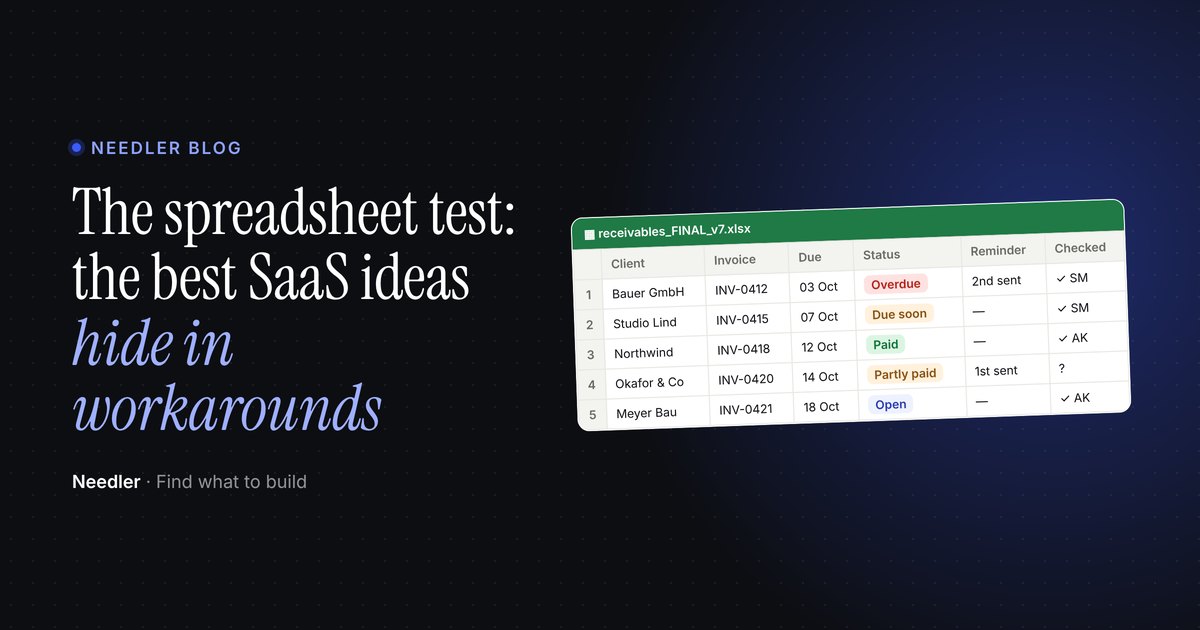
Before a lot of B2B products existed, the job was done in a spreadsheet. Project management, CRM, applicant tracking, inventory, bookkeeping, OKRs: in plenty of companies, each of these lived in a shared Excel file that someone maintained on Friday afternoons, long before anyone bought software for it.
A spreadsheet is what people build when they have a real problem and no product that fits. It's demand that has already been proven, by the test that counts most: someone spends their own time on it, every week.
Why workarounds beat every other signal
When you're trying to judge whether a problem is real, most signals are words. "This is so annoying." "Someone should fix this." "I'd totally use that." Words are cheap, and people are polite.
A workaround is behaviour. It tells you three things words can't:
- The problem hurts enough to act on. Nobody builds a twelve-column tracker for a mild irritation.
- It happens regularly. A one-off problem gets solved by hand once. A spreadsheet only exists because the problem comes back.
- There's a budget, even if it's hidden. If a person spends three hours a week maintaining a sheet, the company is already paying for the problem, in salary.
In Needler's scoring, "workaround today" is one of six strength signals, and it's the one I'd keep if I could only keep one.
The anatomy of a workaround spreadsheet
You learn a lot from what a spreadsheet has in it. When someone describes theirs, or shares a template, read it like a product spec.
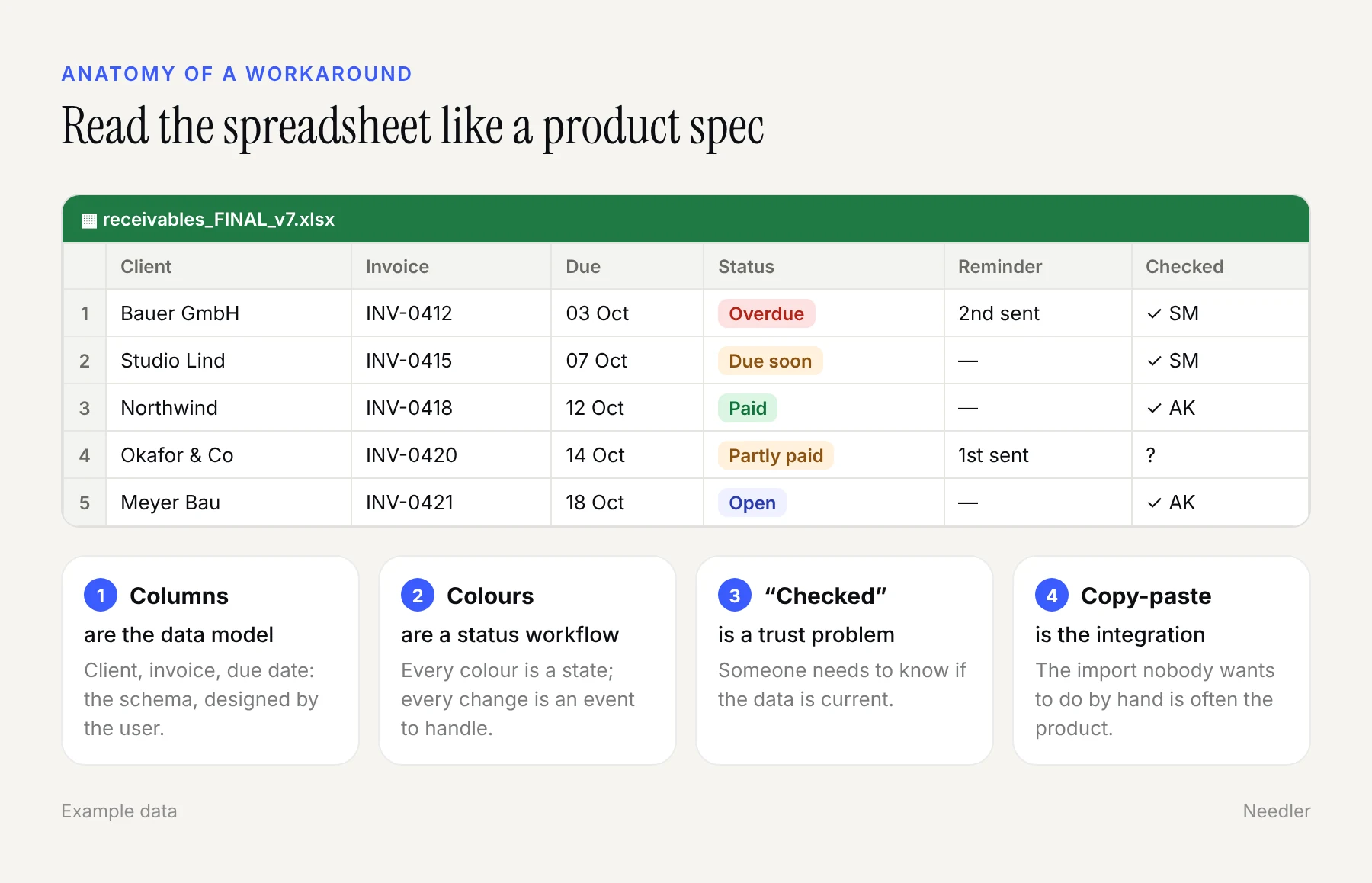
- The columns are the data model. Client, invoice number, due date, status, last reminder sent. That's your database schema, designed by the user.
- Colour coding is a status workflow. Red, yellow, green. Every colour is a state, and the moments someone changes a colour are the events your product needs to handle.
- The "checked by" or "last updated" column is a trust problem. Someone needs to know whether the data is current. That's a feature.
- Formulas that break are the pain point. "The VLOOKUP breaks every time someone adds a row" is someone telling you what's fragile.
- The copy-paste step is the integration. If they export from one tool and paste into the sheet, the product starts by doing that import.
Where to find other people's spreadsheets
People rarely post "here is my workaround". They mention it on the way to a complaint. Some places to look:
- Search Hacker News comments for
"spreadsheet" "every week"or"we use a spreadsheet"(see my list of Hacker News search queries). - On Reddit, search a profession's subreddit for "template", "tracker" or "how do you keep track".
- Look at template marketplaces for Notion, Airtable and Google Sheets. A paid template with hundreds of sales is a validated workflow in a format that doesn't scale.
- Search job postings for "maintain spreadsheets" or "manual data entry" plus a domain. Companies are describing the workaround and the salary that pays for it.
- Ask. "Can you show me how you track this today?" is the most useful question in a customer interview, and most people like showing off their systems.
Which spreadsheets are worth a product
Not every workaround deserves software. Plenty of spreadsheets are fine as they are. These questions separate the two.
Does it involve more than one person?
A personal budget sheet works because one person owns it. The pain starts when three people edit the same file, nobody knows which version is current, and someone overwrites a formula. Collaboration problems are where spreadsheets break down first.
Does it pull data from somewhere else?
If the sheet is filled by copying from email, a bank export, an invoicing tool or a supplier portal, the manual step is the real problem. Automating that import is often the whole product.
Does something happen because of it?
Sheets that trigger actions ("when this turns red, call the client") are workflows dressed as tables. A product can send the reminder; a spreadsheet can't.
Would a mistake cost money?
A missed invoice, an expired certificate, a double-booked room. If an error in the sheet has a price, there's a budget for avoiding it.
How many people maintain a sheet like this?
One clever operations person with a custom tracker is an anecdote. A template that thousands of people have copied is a market.
A rough way to size it
You can estimate what a workaround is worth before talking to anyone, with a deliberately crude formula:
hours per week × hourly cost × 52 = what the problem costs per year
Take a hypothetical office manager who spends three hours a week reconciling appointment no-shows against deposits, at a loaded cost of €35 an hour. That's €5,460 a year. A tool at €49 a month (€588 a year) that removes most of it is an easy decision, if it's reliable.
The formula is rough on purpose. It isn't there to produce a market size. It's there to tell you whether the problem is worth €10 a month or €500, which decides almost everything about how you'd sell it.
The trap: replacing the spreadsheet entirely
A common mistake is to build "a better spreadsheet" for the domain: a full app with every column, view and setting the sheet had. That loses to the spreadsheet almost every time, because the spreadsheet is free, flexible and already set up.
Products that win against spreadsheets usually do one thing the sheet can't:
- They fetch the data so nobody has to paste it.
- They act on it: reminders, notifications, filings, payments.
- They make it shared and trustworthy: one current version, history, who changed what.
Start with that one thing. Keep an export to CSV so people can keep their sheet if they want to. Many will stop opening it on their own.
Turning a workaround into a validation step
Once you've found a promising spreadsheet, the next step is cheap: find five people who maintain one like it, ask them to walk you through it, and ask what they'd stop doing if it went away. If at least two of them ask whether they can try what you're building, you've got something. My seven-day validation plan has the details.
Needler looks for these workarounds in public posts and comments and scores them, along with five other signals. This week's free idea shows what that looks like in practice.