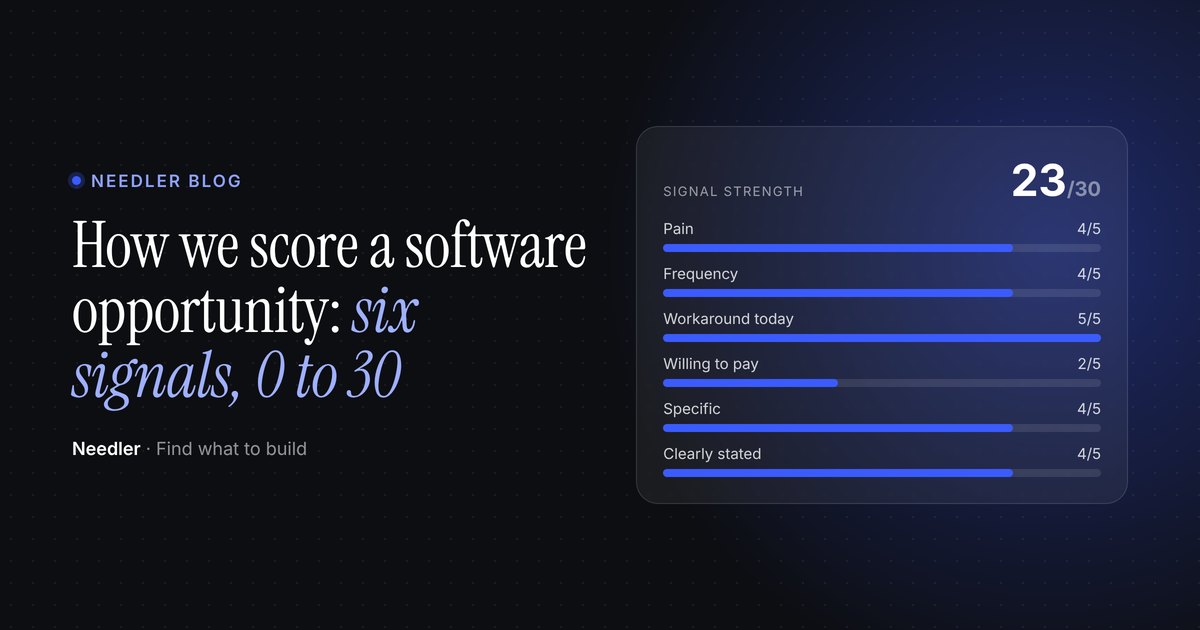
Every idea Needler publishes comes with a number between 0 and 30. It's the first thing people look at, so it should be clear where it comes from and what it can't tell you. This post is that explanation.
The strength score is the sum of six signals, each scored from 0 to 5 by a language model, based only on what the original post says. 18 or more counts as strong. The criteria below are the exact words the model is given.
From a post to a scored brief
A score only makes sense if you know what was scored. Here's the path a post takes:
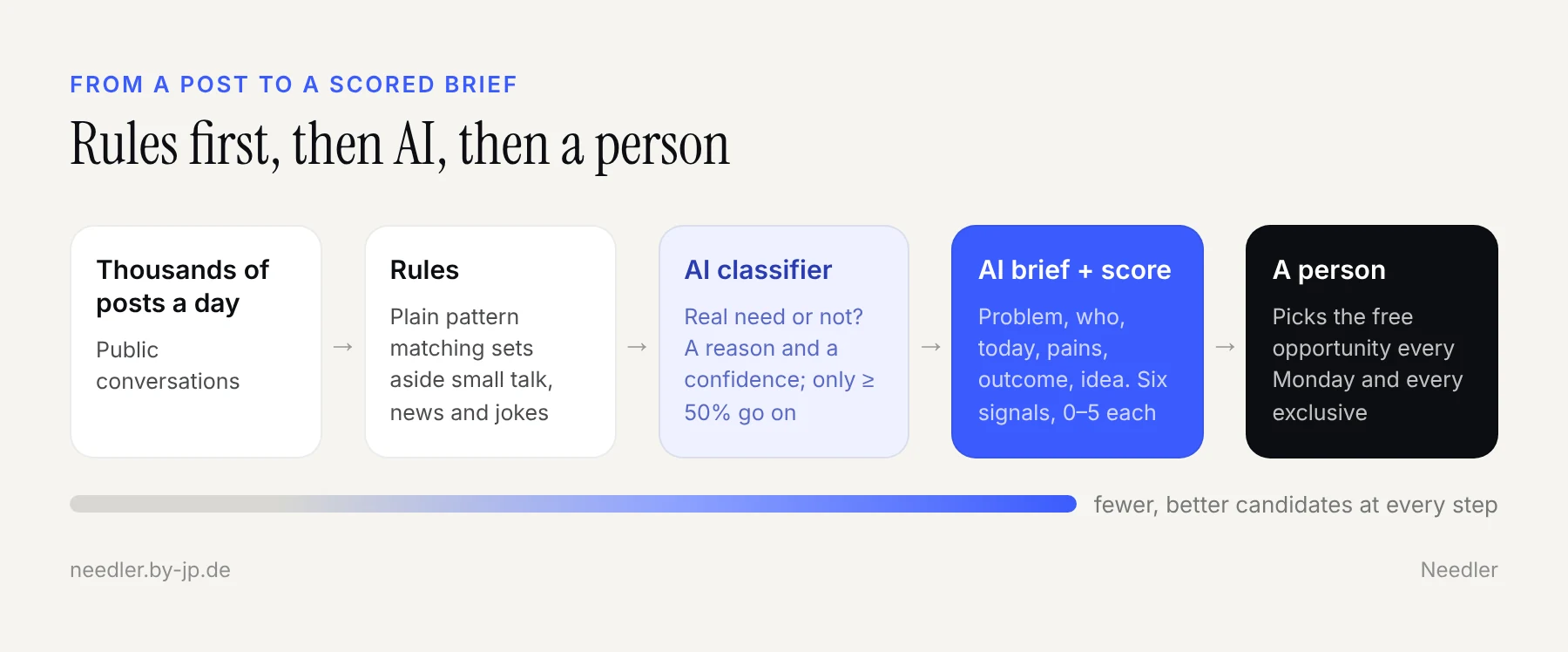
- Rules first. Plain pattern matching, no AI, sets aside the vast majority of posts that clearly aren't about a need: news, jokes, opinions, small talk. It's cheap and predictable, and it means the AI only sees posts with a chance of mattering.
- An AI classifier reads each remaining post and decides whether it describes a real need, with a one-line reason and a confidence. Only posts it's at least 50% sure about go on.
- A second, larger model writes the brief: the problem, who has it, what they do today, the pains, the outcome they want and a product idea. In the same step it scores the six signals.
- I pick. I choose and check the free idea every Monday and every exclusive myself. I also label posts by hand regularly to measure how often the AI agrees with me.
Every brief shows which model scored it, which version of the prompt it used and how confident it was.
The six signals
Each signal answers one question about the problem. The quoted phrase is the exact criterion in the model's instructions.
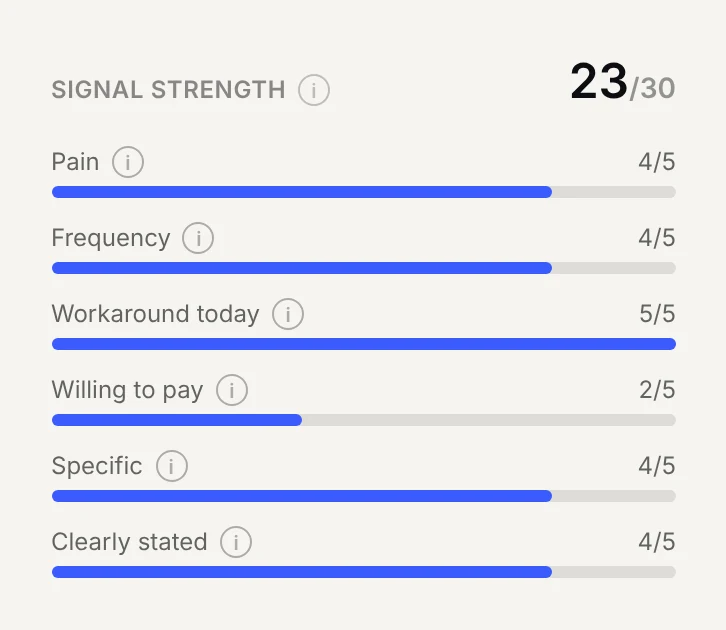
Pain: "how severe"
How much the problem hurts the people who have it. 0 is a mild annoyance. 5 costs real money, time or customers.
Pain alone is misleading, which is why it's only one of six. People write most passionately about things that annoy them once, like a bad support call. That's a lot of pain and no product.
Frequency: "how often it occurs"
0 is once in a while. 5 is daily or weekly, part of the routine.
Frequency is what turns pain into a habit someone wants to break. A problem that comes up every Monday gets a budget. One that comes up once a year gets a sigh.
Workaround today: "already spends time/money working around it"
0 means nothing is done about it. 5 means manual processes, spreadsheets, extra staff or paid tools.
This is my favourite signal, because it measures behaviour rather than words. If someone maintains a spreadsheet every week to cope with a problem, the problem is real. I wrote a whole post on why workarounds are the best signal.
Willing to pay: "explicit intent to pay"
0 is no mention of paying. 5 is "I'd pay for this", with a price or budget.
This is the rarest high score. Most people don't talk about money in public, so a low score here is normal and doesn't kill an idea. A high one is worth a lot. More in how to tell real willingness to pay from polite interest.
Specific: "concrete rather than vague"
0 is a vague wish. 5 is a precise workflow with names of tools and steps.
Specific problems are buildable. "Project management is hard" isn't a product. "Our three freelancers log hours in a spreadsheet and I re-type them into the invoicing tool every month" is.
Clearly stated: "clearly states a problem"
0 means the problem is only implied. 5 means someone says plainly: this is a problem for us.
This one protects against over-interpretation. A post about something else that hints at a need gets a low score here, so it doesn't get rated as highly as a post that's actually about the problem.
Why a sum, and why 18
I could have weighted the signals or trained a model to predict "success". I didn't, for two reasons.
A sum is easy to check. You can look at the six numbers, read the brief and decide whether you agree. A weighted model output would be a number you have to take on trust.
Ideas are good in different ways. A problem with a strong workaround and no mention of money can be as promising as one with an explicit price. A sum lets several moderate signals add up instead of one dominating.
18 out of 30 is where I draw the line for "strong": an average of 3 per signal, which means each part of the story is at least moderately present. It's a convention, not a law of nature. A 16 with a 5 for workaround can be more interesting than a 19 that's all pain and clarity. Look at the parts.
What the score can't tell you
The score is a reading of one post by one model. So it has limits:
- It only knows what the post says. If someone has a huge problem but describes it in a single line, the score is low. If someone writes a long, vivid rant about a minor issue, it can come out high.
- AI misreads sarcasm. "I'd love to pay another €500 a month for this" can be read as willingness to pay. My hand-labelled checks catch some of these, not all.
- One post isn't a market. A strong score means this person describes a strong problem. Whether many people have it is a separate question.
- It says nothing about competition. A problem can score 25 and already have three good products serving it, which the author just didn't know about.
That's why I publish the parts of the score, not just the total, and why every brief says plainly that AI wrote it.
How to use the score
Treat it as a sorting tool, not a verdict:
- Sort by strength to decide what to read first.
- Look at the breakdown to see why something is strong. Workaround and frequency are the most reliable parts.
- Read the brief and ask whether you recognise the problem, or know people who have it.
- Then go and check: search for the same problem elsewhere, and talk to the people who have it. My seven-day validation plan describes how.
The best way to judge whether the scoring is useful to you is to look at a real example. This week's free idea shows the full brief with all six scores, picked by me.