Don't brainstorm ideas, collect problems. Look for people who describe a specific, recurring problem in their own words and who already spend time or money working around it. Two or three of those from different people, in different places, is worth more than any idea you came up with in the shower.
The rest of this post covers where to look, what to listen for, and how to tell a real problem from one that only sounds like one.
Why "what should I build?" is the wrong question
Ask a room of developers for startup ideas and you get the same list every time: a better to-do app, a habit tracker, a tool for developers, something with AI for meetings. None of these are bad. They're just ideas that start from the builder, not from someone with a problem.
The question that works better is: who is annoyed, how often, and what are they doing about it today?
That question has an answer you can check. "What should I build?" doesn't.
It also changes what you do on a Saturday. Instead of opening an editor, you open a few forums and start reading. It feels slower, but it usually isn't.
The demand ladder
Not every complaint is equal. When you read what people write, sort what you find into five rungs. The higher the rung, the more it's worth.
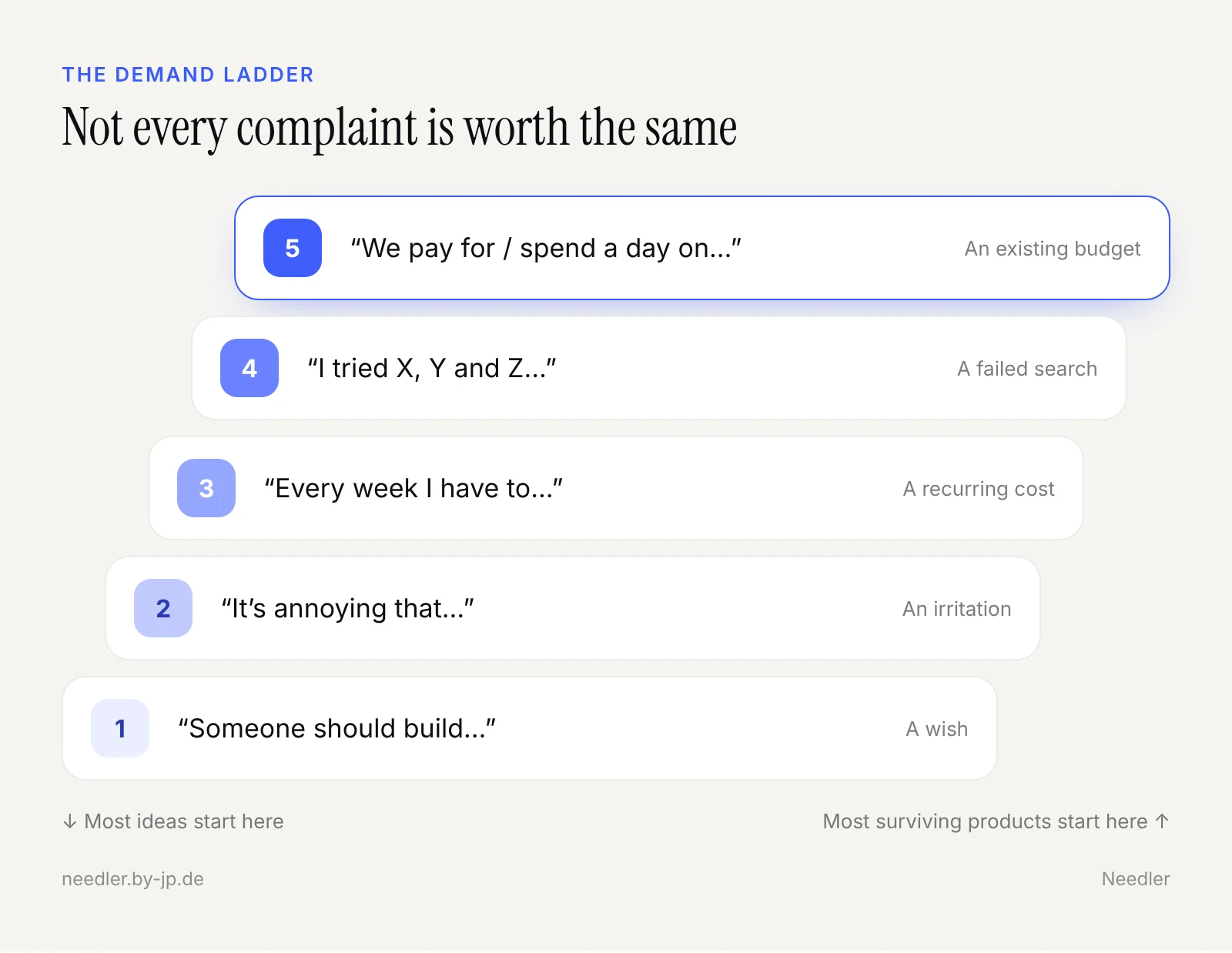
- "Someone should build…" Nobody in this sentence has the problem. It's a wish, often from someone who will never use the thing.
- "It's annoying that…" A real person with a real irritation, but no sign it costs them anything.
- "Every week I have to…" Now there's frequency. Frequency is what turns an irritation into a habit someone wants to break.
- "I tried X, Y and Z and none of them…" They looked for a solution and didn't find one that fits. The market exists; the existing answers miss.
- "We currently pay for / spend a day on…" They already pay for the problem, in money or in hours. You're not creating a budget, you're redirecting one.
Most ideas people build sit on rung one. Most products that survive started on rung four or five.
Where people describe their problems for free
People write their problems down in public every day, unprompted and in detail. Some places are better than others because the people there are specific about their work.
- Hacker News, especially "Ask HN" threads and the comments under launches. People explain what they tried and why it didn't work. I wrote a separate guide with search queries that surface real problems on Hacker News.
- Subreddits for a profession, not for startups. r/accounting, r/sysadmin, r/Dentistry, r/msp. The posts are written by the people who have the problem, for peers who understand it.
- Reviews of existing tools. The two- and three-star reviews on G2, Capterra or the app stores are lists of unmet needs with a job title attached.
- GitHub issues of popular open-source tools. A feature request with sixty thumbs-up and a two-year-old "won't fix" label is demand nobody is serving.
- Industry forums and Slack or Discord communities, where people ask "how do you all handle…?". That question is useful because it means there's no obvious answer.
- Job postings. A company hiring a person to do a repetitive task by hand is telling you what that task is worth per year.
What these places have in common: the people writing aren't pitching anything. They're just trying to get through their week.
What to write down for each problem
Reading without notes is entertainment. For each post that looks promising, capture the same six things. It takes a minute and it makes problems comparable later.
| Field | Question | Example |
|---|---|---|
| Who | Who exactly has it? Job, company size, context | Office manager at a 12-person dental practice |
| Problem | What goes wrong, in their words | "Insurance pre-approvals get lost between fax and email" |
| Today | What do they do instead? | A shared spreadsheet, checked by hand twice a day |
| Frequency | How often does it happen? | Several times a day |
| Cost | What does it cost them? | Two hours a day, occasional lost revenue |
| Pay | Any sign they'd pay? | "We'd happily pay for something that just tracks this" |
The example is made up, but it's the shape you want. Notice that the product idea isn't in the table. You don't need one yet.
Five tests before you get excited
A good-looking problem still has to pass a few checks. Run every candidate through these before you spend a weekend on it.
1. Is it said by different people, in different places?
One post is an anecdote. The same problem from three people who don't know each other, on two different sites, is a pattern. Search for the problem in other words before you trust it.
2. Is there a workaround?
If nobody does anything about the problem today, it probably doesn't hurt enough. A spreadsheet, a script, a VA, a weekly manual export: those are the signs that matter. I think workarounds are the single best signal there is, and I wrote a whole post about the spreadsheet test.
3. Is the person who has the problem the person who pays?
A nurse may hate the scheduling system, but the hospital's IT department buys it. That's not a dealbreaker, but it changes who you need to convince and how long it takes.
4. Can you reach these people?
If the only people with the problem are in a market you can't name, a channel you can't find and a language you don't speak, it's a great problem for someone else.
5. Is it specific enough to build for?
"Managing clients is hard" is a category. "Freelance translators can't see which clients still owe them money across three invoicing tools" is a product. Keep going until the problem names a workflow.
A worked example
Here's what the process looks like on an actual afternoon, with the details changed.
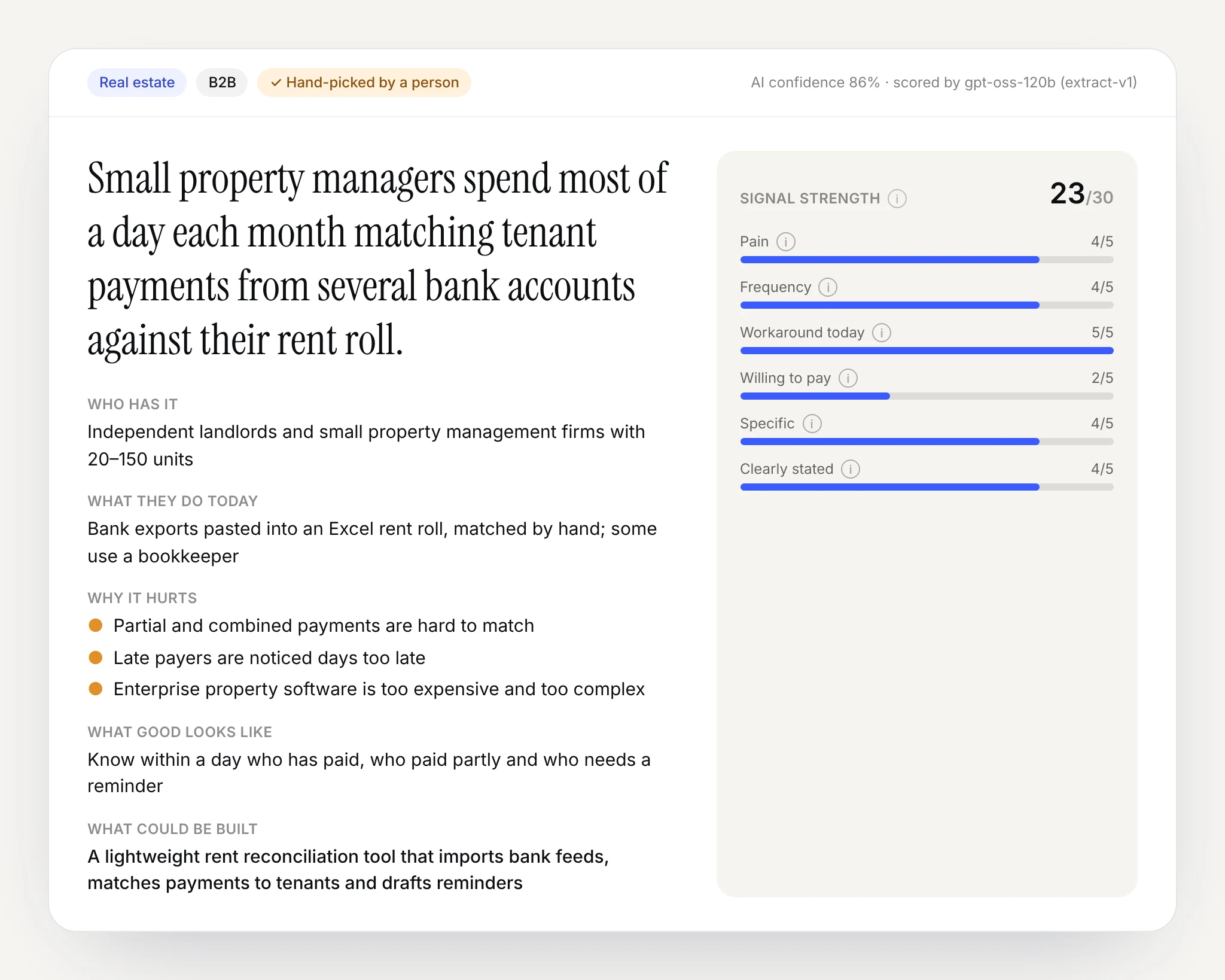
You notice a comment from someone who runs a small property management company. They say they reconcile tenant payments from two bank accounts against a rent roll in Excel every month, and it takes "most of a day". A week later you see a Reddit thread where a landlord with forty units asks how others "keep track of who paid without losing their mind". The answers: a spreadsheet, a bookkeeper, and one person recommending a tool that three others say is too expensive and built for large portfolios.
That's rung five (they pay in hours), from different people, in different places, with a clear gap between "spreadsheet" and "enterprise software". It doesn't mean you should build it. It means it has earned a week of proper validation.
Mistakes that waste months
- Falling for your own idea first and then searching for proof. You'll find it. Confirmation is cheap on the internet.
- Counting upvotes instead of people. A post with 500 upvotes is one person's problem plus 499 people who agreed it was well written.
- Treating "I'd use that" as demand. People say that to be nice. Only paying, or describing what they pay today, counts. See how to tell real willingness to pay from polite interest.
- Ignoring boring markets. The least glamorous problems (invoicing, scheduling, compliance, reconciliation) are where people pay most reliably.
- Stopping at one source. Every community has its own bias. Developers on Hacker News over-index on developer tools; a single subreddit can be an echo chamber.
Doing this at scale
The method above works by hand. It's also slow: reading a few hundred posts to find a handful that matter, and remembering the one from three weeks ago when a similar one shows up.
That's the part I automated with Needler. It reads thousands of public posts and comments a day, sets aside small talk with simple rules, lets a language model judge which posts describe a real need, and turns those into briefs in the format of the table above, with six strength scores. Every Monday I pick one brief and give it away for free, so you can see what the output looks like before you decide whether it's useful to you.
It doesn't replace talking to people. It tells you who to talk to, and what to ask.
Checklist
Before you write a line of code, you should be able to answer yes to most of these:
- I can name who has the problem in one sentence, including their job.
- I've seen it described by at least three different people.
- They do something about it today (spreadsheet, manual work, a paid tool they dislike).
- It happens at least monthly, ideally weekly.
- I know where these people talk to each other.
- At least one of them has mentioned money, time lost or a tool they pay for.
If you're at four or more, go and talk to them. If you're at two, keep reading.