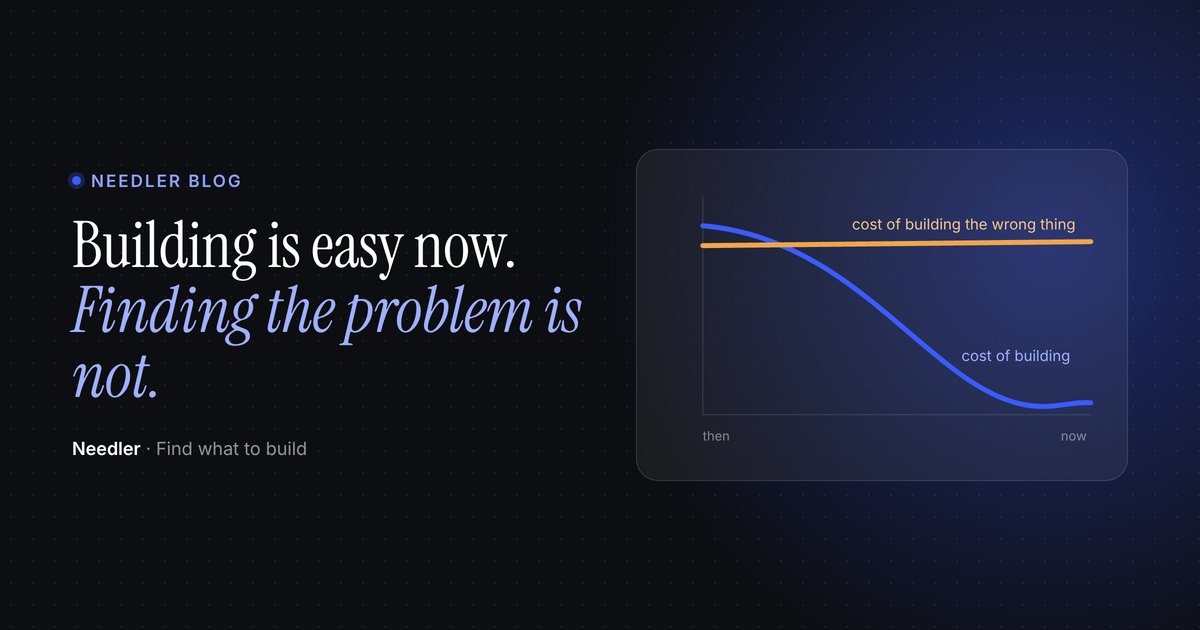
A few years ago, the honest answer to "why didn't you build it?" was usually "it would take months". Today a solo founder with an AI coding assistant ships a working MVP over a weekend. The cost of building has collapsed.
The cost of building the wrong thing has not. Most products still fail for the same reason they always did: not enough people have the problem, or not badly enough to change what they do today.
The scarce part moved
When building was expensive, ideas were cheap because few of them got built. Now far more of them get built, and they all compete with each other. What's scarce is the thing you can't generate: evidence that a specific group of people has a specific problem, often enough and painfully enough to pay for a fix.
And that evidence exists: people write it down every day, in public, without being asked.
What real demand sounds like
Real problems leave recognisable traces in conversations:
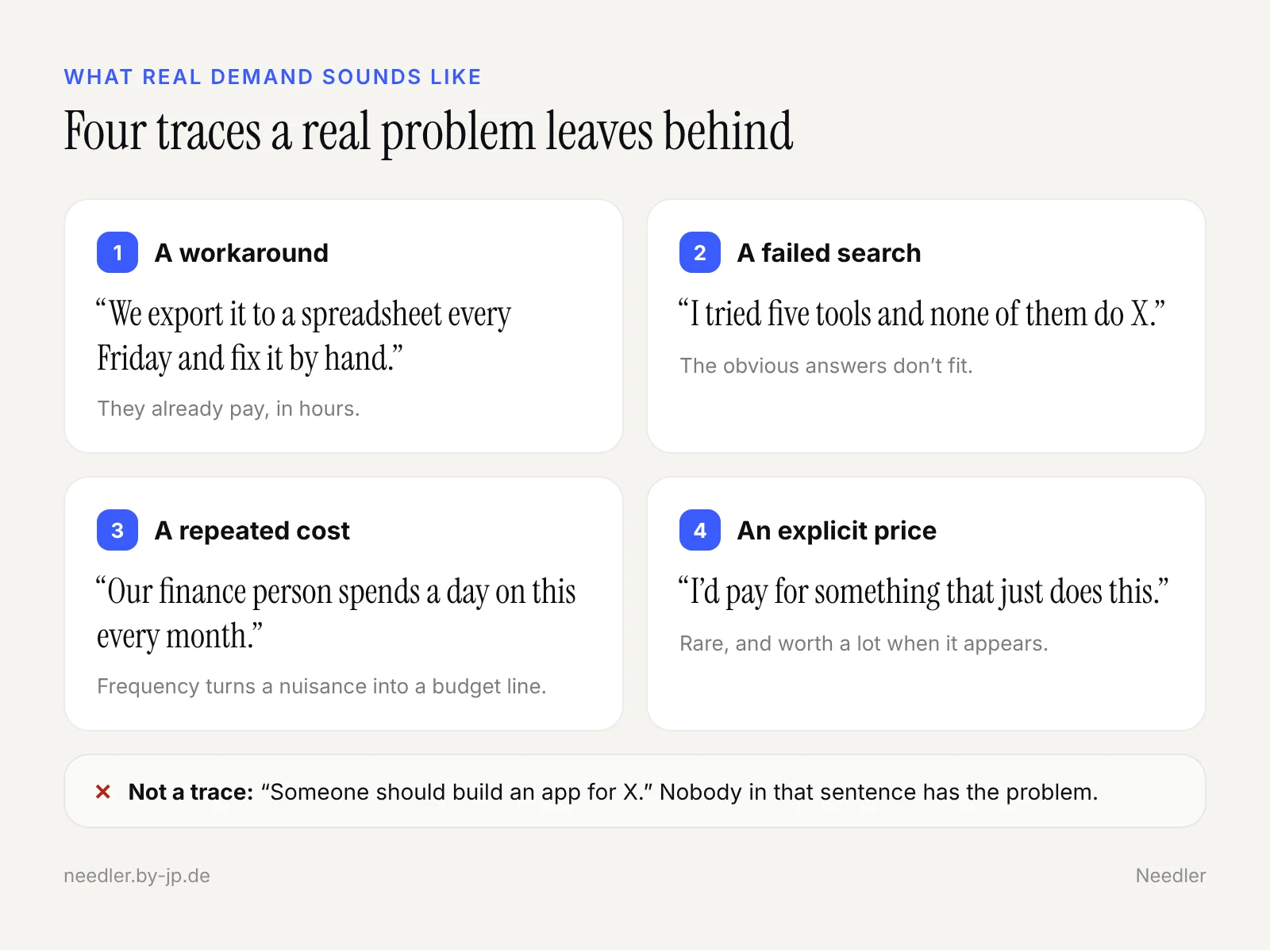
- A workaround. "We export it to a spreadsheet every Friday and fix it by hand." Someone already pays for the problem, in hours.
- A failed search. "I tried five tools and none of them do X." The obvious solutions don't fit.
- A repeated cost. "Our finance person spends a day on this every month." Frequency turns a nuisance into a budget line.
- An explicit price. "I'd pay for something that just does this." Rare, and worth a lot when it appears.
Compare that with "someone should build an app for X". It sounds like demand, but nobody in that sentence has the problem. I go deeper on this in how to tell real willingness to pay from polite interest.
One post is an anecdote
A single complaint proves very little. The signal gets strong when:
- Different people describe the same problem in their own words,
- in different places,
- repeatedly over weeks or months,
- with specific details about who they are and what they do today.
That's tedious to collect by hand, though the right search queries help. It means reading thousands of posts to find a few dozen that matter, and remembering the ones from three weeks ago when a similar one shows up.
Why I built Needler
Needler does the reading. It goes through thousands of public posts and comments a day, sets aside small talk with simple rules, lets a language model decide which of the remaining posts describe a real need, and turns those into neutral briefs: who has the problem, what they do today, how much it hurts and whether they'd pay.
Every brief shows six strength scores and how sure the AI is, and I check the best ones myself. One of them is free every week, so you can judge the quality yourself before you buy anything.
It doesn't replace talking to customers. It tells you which customers to talk to, and what to ask them about. If you want a plan for that part, start with validating an idea in seven days.